
2026 Hyundai Santa Fe: Interior and Towing Capabilities
The Hyundai Santa Fe is a mid-size sport utility vehicle with three rows of seating and a redesigned cabin layout. Its interior emphasizes passenger space, flexible cargo configurations, and integrated technology. In addition, the Santa Fe provides practical towing capability supported by its powertrain options and structural design.
Cabin Layout and Seating Configuration
The Santa Fe provides three rows of seating as standard.
Depending on trim, seating configurations include:
Eight-passenger layout with a second-row bench
Seven-passenger layout with second-row captain’s chairs
The third row folds flat into the cargo floor when not in use. This allows a transition from passenger capacity to expanded cargo space.
Second-row seats slide and recline to adjust legroom distribution between rows. Access to the third row is available through a one-touch second-row release function on select trims.
Front seats offer manual or power adjustment, depending on grade. Heated and ventilated front seats are available on higher trims.
Dashboard and Digital Display System
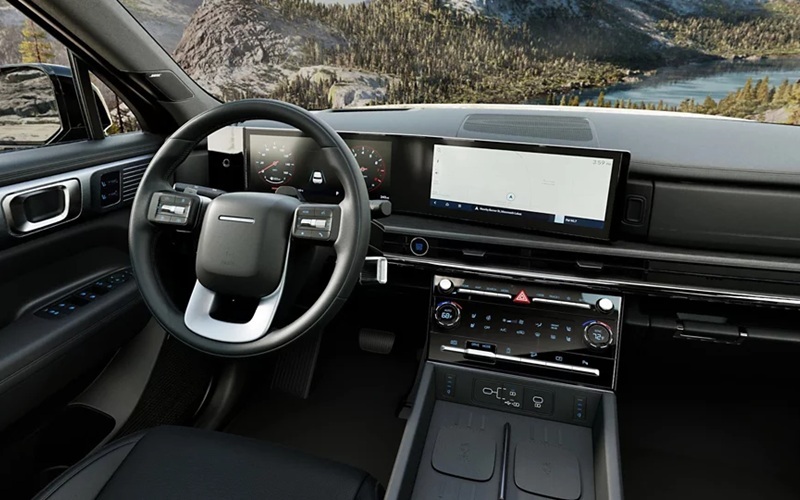
The dashboard design incorporates a panoramic curved display panel.
This layout typically includes:
A digital instrument cluster
A central infotainment touchscreen
On many trims, both displays measure approximately 12.3 inches.
The infotainment system supports:
Apple CarPlay
Android Auto
Bluetooth connectivity
Multiple USB-C charging ports
Physical controls remain for key climate and audio functions, supporting ease of use.
Interior Materials and Finish Options
Interior materials vary by trim level.
Available upholstery options may include:
Cloth seating surfaces
Synthetic leather
Genuine leather
Higher trims may include:
Soft-touch dashboard materials
Ambient interior lighting
Heated steering wheel
The overall cabin layout uses horizontal design elements to emphasize width.
Storage Areas and Practical Features
The Santa Fe interior includes multiple storage solutions.
Key features include:
Large centre console storage compartment
Dual-level console design on certain trims
Front and rear cupholders
Door panel storage pockets
Underfloor cargo storage
A wireless charging pad may be available, depending on the configuration.
Rear seatbacks fold in a 60/40 split in the second row and a 50/50 split in the third row.
Cargo Capacity and Load Flexibility
Cargo volume depends on seat configuration.
With all three rows upright, the cargo area supports daily items such as groceries or small luggage.
When the third row folds flat, cargo capacity increases significantly. Folding both rear rows creates a flat load floor suitable for longer objects.
The squared rear hatch opening supports easier loading of bulky items.
A hands-free smart power liftgate may be available on select trims.
Climate Control and Passenger Comfort
The Santa Fe offers dual-zone automatic climate control as standard.
Higher trims may include:
Tri-zone automatic climate control
Rear climate vents
Heated second-row seats
Rear passengers benefit from dedicated air vents and USB charging ports.
Acoustic glass and insulation contribute to reduced cabin noise at highway speeds.
Powertrain Options
The Santa Fe offers gasoline and hybrid powertrain options.
2.5 L Turbocharged Engine
2.5 L turbocharged four-cylinder gasoline engine
8-speed dual-clutch automatic transmission
This configuration supports both daily driving and towing tasks.
Hybrid Powertrain
1.6 L turbocharged gasoline engine
Electric motor
6-speed automatic transmission
The hybrid system combines gasoline and electric power for improved efficiency.
Powertrain availability depends on trim level.
Drivetrain and Towing Support
Front-wheel drive is standard on certain trims. All-wheel drive is available.
The all-wheel-drive system can adjust torque distribution between front and rear axles when traction loss occurs.
Drive mode selection may include:
Normal
Sport
Snow
These modes adjust throttle response and transmission behaviour.
Towing Capacity
Towing capacity depends on engine selection and drivetrain configuration.
When equipped with the 2.5 L turbocharged engine, the Santa Fe offers a maximum towing capacity of approximately 2,000 kg.
Hybrid configurations offer lower towing capacity than the turbocharged gasoline engine.
A trailer wiring harness and hitch receiver may be available through factory or dealer-installed options.
Trailer Stability and Safety Integration
The Santa Fe includes electronic systems that support towing stability.
These systems may include:
Trailer sway control
Electronic stability control
Anti-lock braking system (ABS)
Trailer sway control can detect lateral trailer movement and apply braking force to help stabilize the vehicle.
Rear parking sensors and camera systems assist during trailer alignment and reversing manoeuvres.
Structural Design and Load Support
The Santa Fe uses a unibody structure with high-strength steel components.
This design supports:
Passenger safety
Torsional rigidity
Balanced weight distribution
The rear suspension uses a multi-link design. This layout supports ride comfort and load management under passenger or cargo weight.
Properly equipped models include reinforced mounting points for hitch installation.
Questions and Answers
How many seating rows does the 2026 Hyundai Santa Fe offer?
It offers three rows of seating as standard.
What size are the digital displays on many trims?
Many trims include dual displays measuring approximately 12.3 inches each.
What is the maximum towing capacity with the 2.5 L turbocharged engine?
When properly equipped, it supports approximately 2,000 kg of towing capacity.
Does the Santa Fe offer all-wheel drive?
Yes. All-wheel drive is available depending on trim level.
What rear suspension design does the Santa Fe use?
It uses a multi-link rear suspension design.


